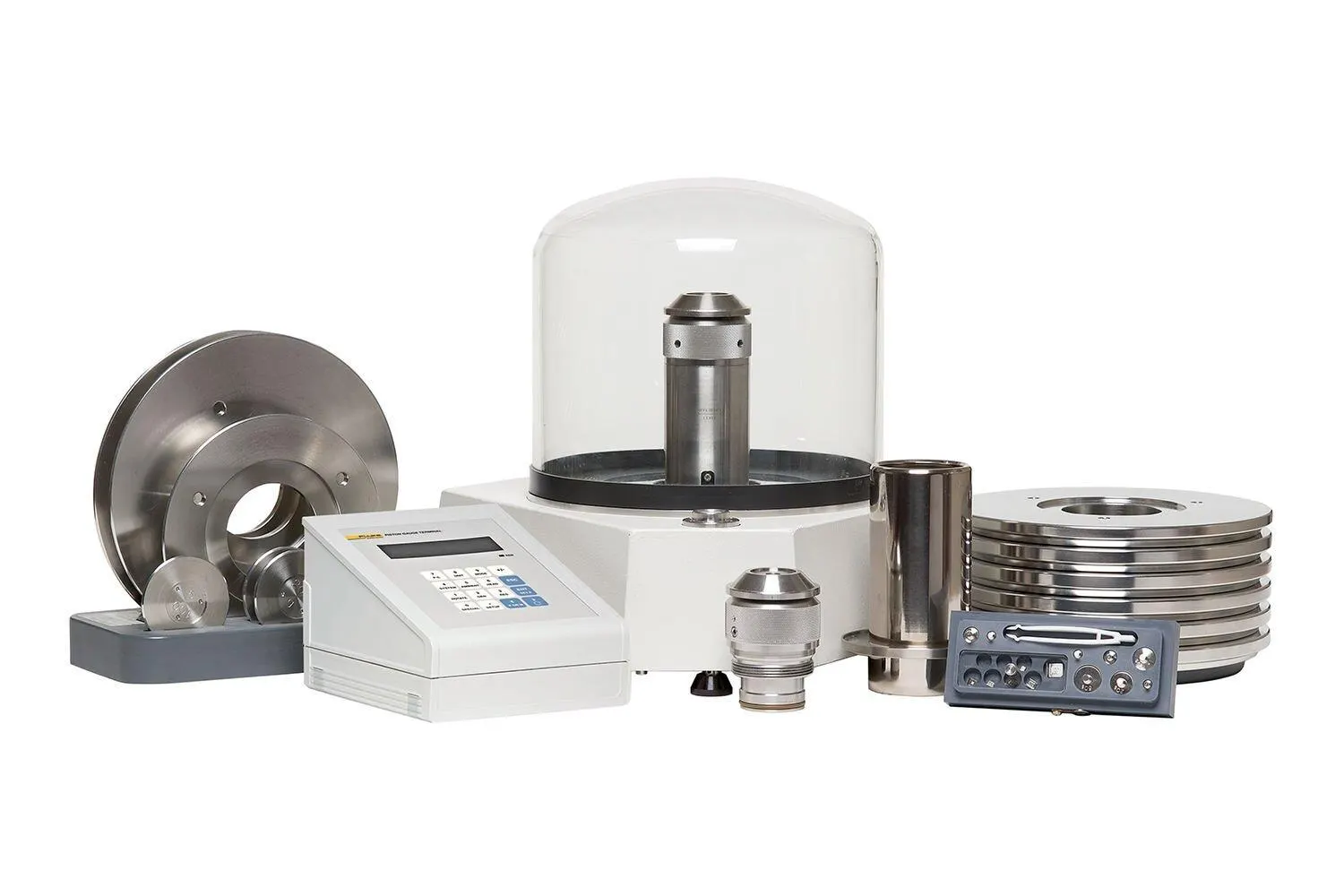
The piston gauge from Fluke Calibration offers pressure calibration standards that provide automated operations and thermal transpiration correction.
The piston gauge from Fluke Calibration offers pressure calibration standards that provide automated operations and thermal transpiration correction.
| Manufacturer part number (MPN) | 3069028 Brand: Fluke Category: Tools Power requirements: 85 V ac to 264 V ac, 47 Hz to 440 Hz, 22 VA max consumption Normal operating temperature range: 18 °C to 28 °C (64 °F to 82 °F) Weight: Instrument platform with no mass loaded: 17 kg (37 lb) PG terminal 1.4 kg (3 lb) Dimensions: Instrument platform (HxWxD): 36 cm x 40 cm x 35 cm (14.5 in x 15.8 in x 13.8 in) Height: top of bell jar Communications ports: RS-232 COM1: Host computer COM2: AMH automated mass handler, external barometer COM3: Automated pressure controller IEEE-488.2: Host computer Maximum pressure ranges: Actual range depends on piston-cylinder and mass set selection |
| Operating media | Gas: air, helium, nitrogen CE conformance: Available, must be specified Mass set specifications: All masses are delivered in molded, reusable transit cases with custom inserts |
| Masses | material: 304L non-magnetic stainless steel Finish: Electropolished Adjustment tolerance: ± 20 ppm of nominal value Accuracy of measured values: ± 5 ppm or 1 mg, whichever is greater Traceability of measured values: National Institute of Standards and Technology (NIST) Temperature: Piston- Cylinder Temperature Range: 0 to 40 degrees C Resolution: 0.01 degrees C Accuracy: ± 0.1 degrees C Ambient Temperature Range: 0 to 40 degrees C Resolution: 0.1 degrees C Accuracy: ± 1 degrees C Barometric pressure with internal sensor: Range: 70 kPa to 110 kPa Resolution: 10 Pa Accuracy: ± 140 Pa Barometric pressure can also be read automatically from any RS-232 device such as DHI RPM4 Relative humidity: Range: 5 % to 95 % RH Resolution: 1 % RH Accuracy: ± 10 % RH Piston position: Range: ± 4.5 mm Resolution: 0.1 mm Piston rotation (rate and deceleration): Range: 2 to 150 rpm Resolution: 1 rpm Vacuum: Range: 0 to 20 Pa Resolution: 0.1 Pa Accuracy: ± 0.1 Pa or 10 % of reading, whichever is greater Pressure measurement uncertainty: Typical pressure measurement uncertainty All sources of uncertainty under typical operating conditions are identified, quantified and combined following ISO/TAG4/WG3. The result is rounded upwards to provide conservative global uncertainty figures for the typical user under typical conditions |
| MOQ | 1 |